


HR document template
Employee termination letter template
A termination letter with a termination summary table and the required final-pay deadline for every state. Copy it, download the Word document, or send a personalized letter to every affected employee at once.
State-specific requirements are in the table below.
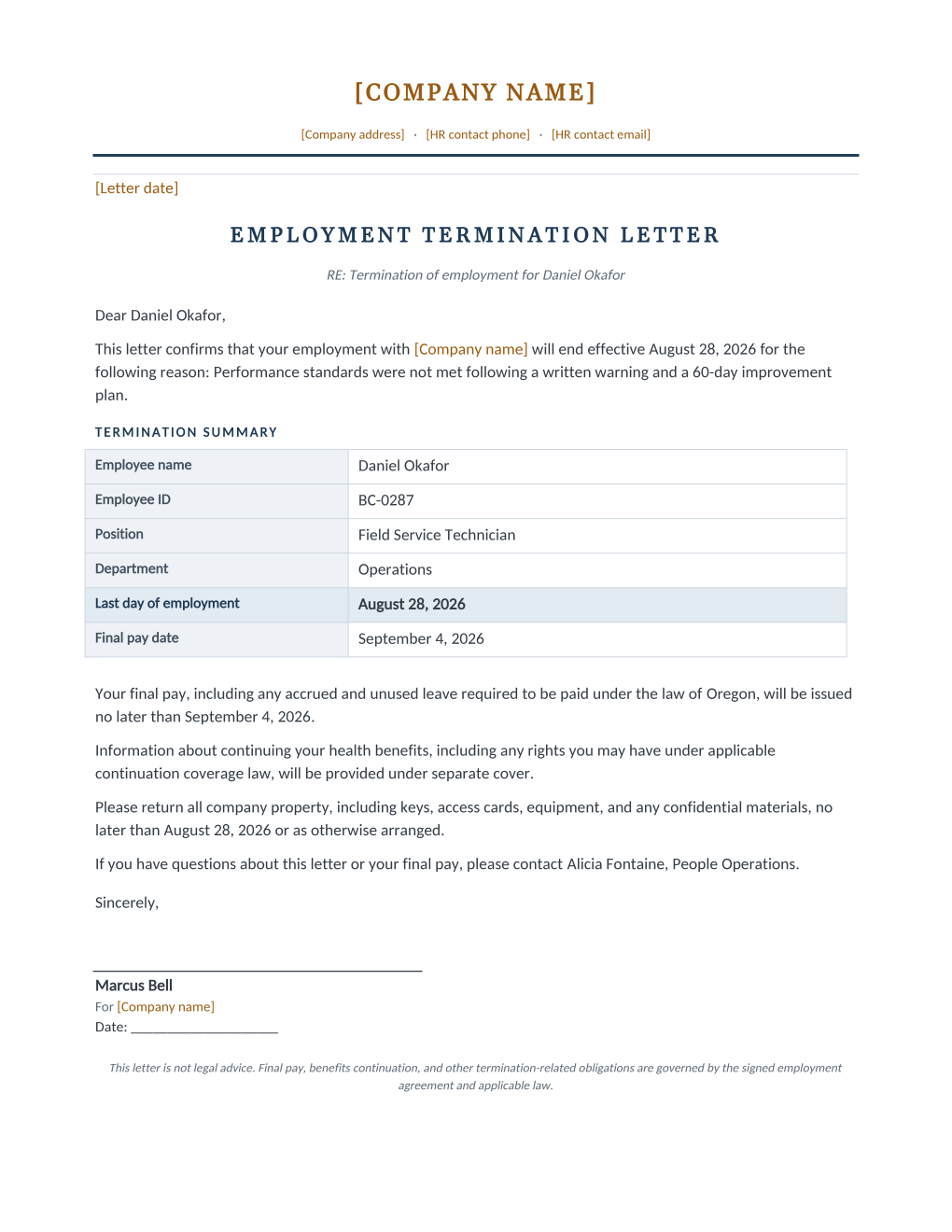
An employment termination letter confirms in writing that an employee's employment is ending, the last day of employment, the reason, and the final pay date, which many states regulate on a stricter timeline than the next regular payday. It is issued at, or shortly before, the employee's last day.
Layoffs and restructurings often affect several employees at once, each with their own last day and final pay date. Upload this letter as a Word template to MailMergic, upload a spreadsheet with each employee's details, and generate one personalized termination letter per row, with the correct dates already filled in.
What is inside the Word download
More than a block of text an AI chat can improvise: a complete, formatted document built for HR teams who send it for real.
- A Termination Summary table with last day of employment and final pay date up front.
- A state-aware final-pay paragraph and a separate note that benefits-continuation information follows under separate cover.
- A company-signed block, since a termination needs the employer's signature, not an employee counter-signature.
- Native Word merge fields for every employee-specific detail, wired for layoffs affecting several employees at once.
The document
Copy the plain version below, or download the formatted Word document with your letterhead and layout built in.
{Letter date}

EMPLOYMENT TERMINATION LETTER
RE: Termination of employment for [Employee Name]

Dear [Employee Name],

This letter confirms that your employment with {Company name} will end effective [Termination Date] for the following reason: [Termination Reason].

TERMINATION SUMMARY
Employee name: [Employee Name]
Employee ID: [Employee ID]
Position: [Job Title]
Department: [Department]
Last day of employment: [Termination Date]
Final pay date: [Final Pay Date]

Your final pay, including any accrued and unused leave required to be paid under the law of [Work Location State], will be issued no later than [Final Pay Date].

Information about continuing your health benefits, including any rights you may have under applicable continuation coverage law, will be provided under separate cover.

Please return all company property, including keys, access cards, equipment, and any confidential materials, no later than [Termination Date] or as otherwise arranged.

If you have questions about this letter or your final pay, please contact [HR Contact].

Sincerely,

______________________________
[Manager Name]
For {Company name}
Date: ____________________
Merge fields: one spreadsheet column each
Filled per employee in a bulk run, straight from your HR spreadsheet.
[Employee Name]Trevor Nakamura[Employee ID]EMP-3305[Job Title]Customer Support Specialist[Department]Support[Termination Date]August 22, 2026[Final Pay Date]August 22, 2026[Termination Reason]elimination of the position as part of a department restructuring[Work Location State]Texas[HR Contact]hr@driftwoodretail.com[Manager Name]Angela RiosFill in once before sending
Your own details, edited one time in Word (marked in amber in the download). No spreadsheet columns needed.
{Letter date}August 15, 2026{Company name}Driftwood Retail GroupFinal paycheck deadlines by state
How quickly a final paycheck must reach a terminated employee, state by state. Several states require payment on the day of discharge or within a few business days, well ahead of the next regular payday; a handful default to the next regular payday under general federal practice with no state-specific deadline statute. The table covers US states only.
| State | Required notice |
|---|---|
| Alabama | No state law sets a specific final paycheck deadline for an involuntary termination; final wages default to the next regular payday under general federal FLSA practice |
| Alaska | Final wages are due within three working days after an involuntary termination, regardless of the reason for discharge |
| Arizona | Final wages are due within seven working days or by the end of the next regular pay period, whichever is sooner, after an involuntary termination |
| Arkansas | Final wages are due by the next regular payday after a discharge or layoff, with double wages owed if payment is not made within seven days of that payday |
| California | Final wages due immediately at the time of an involuntary termination |
| Colorado | Final wages are due immediately at an involuntary termination; if the payroll unit is closed at discharge, within 6 hours of its next opening (24 hours if the unit is off site) |
| Connecticut | Final wages are due no later than the business day following an involuntary discharge (layoffs get until the next regular payday) |
| Delaware | Final wages after a discharge or layoff are due on the later of the next date they would normally be paid under the regular pay cycle, or three business days after the last day worked |
| District of Columbia | Final wages are due no later than the working day following an involuntary discharge (employees who quit get the next payday or 7 days, whichever is earlier) |
| Florida | Florida has no statute setting a final paycheck deadline; final wages are generally due by the next regular payday under federal law |
| Georgia | Georgia has no statute setting a final paycheck deadline for an involuntary termination; final wages are generally due by the next regular payday under federal law |
| Hawaii | Final wages are due immediately at the time of discharge, or by the next working day if conditions prevent immediate payment (an employee who quits without notice is due by the next regular payday) |
| Idaho | Final wages are due by the earlier of the next regularly scheduled payday or 10 days after the termination or layoff (excluding weekends and holidays), or within 48 hours if the employee makes a written request |
| Illinois | Final compensation is due at the time of separation if possible, but in no case later than the next regularly scheduled payday |
| Indiana | Final wages are due by the next regularly scheduled payday for the pay period in which the discharge occurred |
| Iowa | Final wages are due no later than the next regular payday for the pay period in which the wages were earned |
| Kansas | Final wages are due no later than the next regular payday on which the employee would have been paid had employment continued |
| Kentucky | Final wages are due by the next normal pay period following dismissal or within 14 days of the dismissal, whichever is later |
| Louisiana | Final wages due by the next regular payday or within 15 days of the discharge date, whichever occurs first, for an involuntary termination |
| Maine | Final wages due no later than the employee's next established payday after an involuntary termination; if the employee demands payment, it is due within 2 weeks of the demand or the next payday, whichever is earlier |
| Maryland | Final wages due on or before the day the employee would otherwise have been paid, i.e. the next regular payday, after an involuntary termination |
| Massachusetts | Final wages due on the day of discharge for an involuntary termination (a voluntary resignation is due by the next regular payday) |
| Michigan | Final wages due immediately upon discharge, meaning as soon as the amount owed can be determined with due diligence |
| Minnesota | Final wages are immediately due and payable upon the employee's demand after an involuntary termination; the employer then has 24 hours after the demand to pay before being in default |
| Mississippi | Mississippi has no state statute setting a final paycheck deadline for terminated employees; only the federal FLSA baseline of paying by the next regular payday applies |
| Missouri | Final wages due on the day of discharge for an involuntary termination; if the employee requests the wages be sent, the employer has 7 days to get them to the requested location |
| Montana | Final wages due immediately upon discharge or layoff, unless the employer has a written personnel policy extending payment to the next regular payday or within 15 days of separation, whichever occurs first |
| Nebraska | Final wages are due on the next regular payday or within two weeks of an involuntary termination, whichever is sooner |
| Nevada | Final wages are due immediately for both a discharge and a temporary layoff (nonworking status); a voluntary quit allows until the next payday or 7 days, whichever is sooner |
| New Hampshire | Final wages are due in full within 72 hours of a discharge, but wages owed after a layoff are due by the next regular payday |
| New Jersey | Final wages are due no later than the regular payday for the pay period in which the involuntary termination or layoff occurred |
| New Mexico | Wages of a fixed and definite amount are due within 5 days of an involuntary discharge; other wages such as commissions are due within 10 days |
| New York | Final wages due by the next regular payday following an involuntary termination |
| North Carolina | Final wages are due on or before the next regular payday following an involuntary termination |
| North Dakota | Final wages are due at the next regular payday established by the employer; on a discharge the employer must send payment by certified mail to the employee's address on record |
| Ohio | Ohio has no separate termination pay statute; final wages are due on the next regularly scheduled semi-monthly payday under the general wage payment law |
| Oklahoma | Final wages are due on the next regular payday, whether the employee was fired, laid off, or quit |
| Oregon | Final wages are due by the end of the first business day after a discharge or a permanent layoff; a temporary layoff with return within 35 days instead allows payment on the next regular payday (that 35-day carve-out comes from the implementing rule, not the statute text itself) |
| Pennsylvania | Final wages are due on the next regular payday, with no distinction between a firing, layoff, or voluntary quit |
| Rhode Island | Final wages are due on the next regular payday, except that a separation caused by the employer liquidating, merging, selling, or moving the business out of state requires payment within 24 hours |
| South Carolina | Final wages are due within 48 hours of separation or by the next regular payday, which may not be more than 30 days after separation |
| South Dakota | Final wages are due by the next regular payday, though the employer may withhold payment until any company property still held by the employee is returned |
| Tennessee | Final wages are due by the next regular payday or within 21 days of discharge, whichever is later |
| Texas | Final wages are due no later than the sixth calendar day after a discharge or layoff (versus the next regular payday for a voluntary quit) |
| Utah | Final wages are due within 24 hours of an involuntary separation (versus the next regular payday for a voluntary quit) |
| Vermont | Discharged employees must be paid within 72 hours of discharge (employees who quit are paid on the last regular payday, or the following Friday if there is none) |
| Virginia | Final wages due on or before the date the employee would have been paid for that work had employment not been terminated, i.e. the next regular payday; same rule for quits |
| Washington | Final wages due at the end of the established pay period following separation, whether the employee is discharged or quits |
| West Virginia | Final wages due on or before the next regular payday, whether the employee is discharged, laid off, or resigns |
| Wisconsin | Final wages due by the next regular payday (and no more than 31 days after the wages were earned); within 24 hours if the separation results from a merger, liquidation, relocation, or business closure |
| Wyoming | Final wages due no later than the employer's next regularly scheduled payroll date under its usual practice (or the time set by a collective bargaining agreement), whether the employee quits or is discharged |
Last reviewed August 2026. Spotted a change in your state? Tell us at support@mailmergic.com.
These templates and state tables are general information, not legal advice. Employment law varies by state and country and changes often; the tables on these pages cover US states only, while employment documents like these can create binding obligations in any jurisdiction. Confirm the current requirements for your jurisdiction or consult an employment attorney before sending.
Before you send this letter
- 1.Check the Final Pay Date against your state's deadline in the table below before sending; it is often shorter than the next regular payday.
- 2.Have HR or legal review the Termination Reason wording before it goes out.
- 3.Check WARN Act and any state-equivalent thresholds if the termination is part of a larger layoff.
- 4.Confirm benefits-continuation information is sent separately as required.
- 5.Do not characterize the employee in the letter; keep it factual.
- 6.Keep a copy of the delivered letter on file.
When to use this template
Individual terminations
Generate a termination letter with the correct state final-pay deadline already reflected in your process.
Layoffs and restructurings
Send personalized termination letters to every affected employee at once, each with their own last day and final pay date.
Multi-state employers
Track the different final-pay deadlines across states without checking the table by hand for every termination.
Send it to every employee at once
One document, one spreadsheet, one personalized copy per employee. That is what MailMergic is for.
Upload the document template
Use the Word download as-is, or edit it first. The merge fields are already in place.
Upload your employee spreadsheet
One row per employee: name, ID, role, dates, whatever the document needs. Excel, CSV, and Google Sheets all work.
Generate and deliver
One personalized document per employee. Download all as PDFs, or email each employee with delivery and open tracking.
Termination letter FAQ
How much notice does an employer have to give before firing an employee?
How fast does a final paycheck have to be issued after termination?
Does a termination letter have to state a reason?
Can I send termination letters to a whole list of employees at once?
Other HR templates
Offer letter
A formal offer with a terms summary table and a signature block ready for the candidate to accept.
Employment contract
Nine numbered clauses covering compensation, hours, leave, confidentiality, and termination.
Confidentiality agreement
Protects company information and assigns work inventions, with a state invention-assignment carve-out clause.
Performance improvement plan
Documented concerns, success criteria, support, and a review date, with a receipt-only acknowledgment.
Warning letter
A formal written warning with an incident summary and a receipt-only acknowledgment signature.
Separation agreement
Severance and release terms on the federal consideration and revocation timeline, with state add-ons noted.
Disciplinary action form
A structured incident record with an acknowledgment signature, not an admission of agreement.
Employee information form
Employment details and emergency contacts in one form, with a signature confirming accuracy.
Onboarding checklist
Before day one, first day, and first month tasks, with a named buddy for every new hire.
All HR document templates
Browse the full set of free HR document templates.
These templates and state tables are general information, not legal advice. Employment law varies by state and country and changes often; the tables on these pages cover US states only, while employment documents like these can create binding obligations in any jurisdiction. Confirm the current requirements for your jurisdiction or consult an employment attorney before sending.