


HR document template
Confidentiality and invention assignment agreement template
A confidentiality and IP assignment agreement with a state-aware invention-assignment carve-out clause. Copy it, download the Word document, or send a personalized agreement to every new hire at once.
State-specific requirements are in the table below.
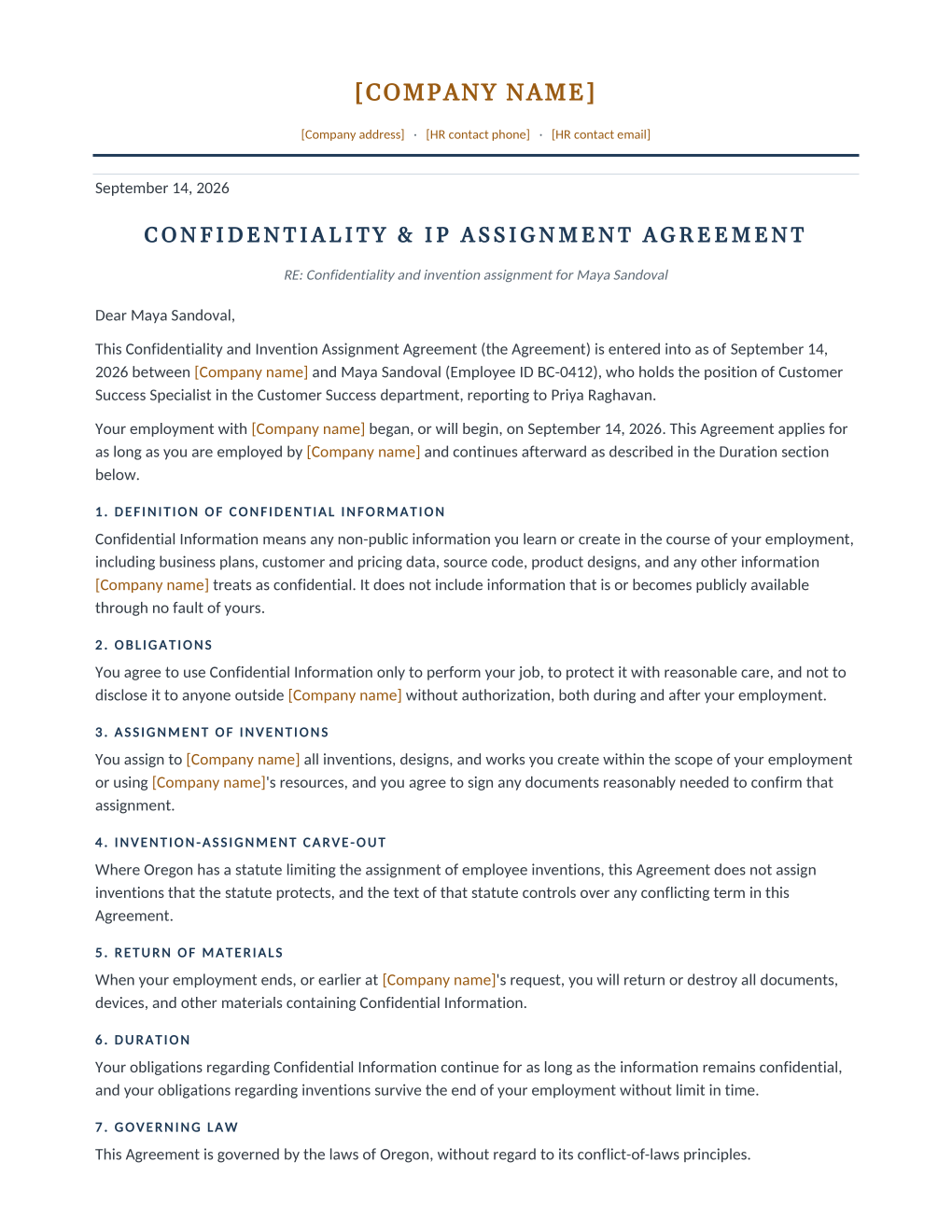
A confidentiality and invention assignment agreement protects a company's proprietary information and clarifies that inventions employees create on the job belong to the company. Employers typically have new hires sign it alongside, or shortly after, their employment contract, before the employee has access to confidential systems or projects.
Every new hire needs their own signed copy, with their name, employee ID, and work location filled in correctly (the work location state also determines which invention-assignment carve-out statute, if any, applies). Upload this agreement as a Word template to MailMergic, upload your new-hire spreadsheet, and generate one personalized agreement per employee.
What is inside the Word download
More than a block of text an AI chat can improvise: a complete, formatted document built for HR teams who send it for real.
- Seven numbered clauses: definitions, obligations, invention assignment, the state carve-out, return of materials, duration, and governing law.
- A state-aware invention-assignment carve-out clause tied to the employee's actual work location state.
- A two-signature block for the company and the employee.
- Native Word merge fields for name, employee ID, role, manager, and work location state, wired for bulk onboarding.
The document
Copy the plain version below, or download the formatted Word document with your letterhead and layout built in.
[Agreement Date]

CONFIDENTIALITY & IP ASSIGNMENT AGREEMENT
RE: Confidentiality and invention assignment for [Employee Name]

Dear [Employee Name],

This Confidentiality and Invention Assignment Agreement (the Agreement) is entered into as of [Agreement Date] between {Company name} and [Employee Name] (Employee ID [Employee ID]), who holds the position of [Job Title] in the [Department] department, reporting to [Manager Name].

Your employment with {Company name} began, or will begin, on [Start Date]. This Agreement applies for as long as you are employed by {Company name} and continues afterward as described in the Duration section below.

1. DEFINITION OF CONFIDENTIAL INFORMATION
Confidential Information means any non-public information you learn or create in the course of your employment, including business plans, customer and pricing data, source code, product designs, and any other information {Company name} treats as confidential. It does not include information that is or becomes publicly available through no fault of yours.

2. OBLIGATIONS
You agree to use Confidential Information only to perform your job, to protect it with reasonable care, and not to disclose it to anyone outside {Company name} without authorization, both during and after your employment.

3. ASSIGNMENT OF INVENTIONS
You assign to {Company name} all inventions, designs, and works you create within the scope of your employment or using {Company name}'s resources, and you agree to sign any documents reasonably needed to confirm that assignment.

4. INVENTION-ASSIGNMENT CARVE-OUT
Where [Work Location State] has a statute limiting the assignment of employee inventions, this Agreement does not assign inventions that the statute protects, and the text of that statute controls over any conflicting term in this Agreement.

5. RETURN OF MATERIALS
When your employment ends, or earlier at {Company name}'s request, you will return or destroy all documents, devices, and other materials containing Confidential Information.

6. DURATION
Your obligations regarding Confidential Information continue for as long as the information remains confidential, and your obligations regarding inventions survive the end of your employment without limit in time.

7. GOVERNING LAW
This Agreement is governed by the laws of [Work Location State], without regard to its conflict-of-laws principles.

Sincerely,

______________________________
{Signer name and title}
For {Company name}
Date: ____________________

______________________________
[Employee Name]
Employee
Date: ____________________
Merge fields: one spreadsheet column each
Filled per employee in a bulk run, straight from your HR spreadsheet.
[Agreement Date]August 12, 2026[Employee Name]Sofia Marchetti[Employee ID]EMP-4471[Job Title]Software Engineer[Department]Engineering[Manager Name]Ilya Petrov[Start Date]August 24, 2026[Work Location State]CaliforniaFill in once before sending
Your own details, edited one time in Word (marked in amber in the download). No spreadsheet columns needed.
{Company name}Northlight Software Inc.{Signer name and title}Ilya Petrov, Engineering DirectorInvention-assignment carve-out statutes by state
A minority of states limit what inventions an employer can require an employee to assign in a confidentiality and invention assignment agreement, typically protecting inventions made entirely on the employee's own time without company resources. Nevada runs the opposite direction, defaulting invention ownership to the employer. The table covers US states only; use the [Work Location State] merge field to match the agreement to where each employee actually works.
| State | Required notice |
|---|---|
| Alabama | No employee-invention statute; the agreement's own terms govern |
| Alaska | No employee-invention statute; the agreement's own terms govern |
| Arizona | No employee-invention statute; the agreement's own terms govern |
| Arkansas | No employee-invention statute; the agreement's own terms govern |
| California | Employer cannot require assignment of an invention the employee developed entirely on their own time, without using employer equipment, supplies, facilities, or trade secrets, unless it relates to the employer's business or actual or anticipated research, or resulted from work done for the employer; the employer must also give written notice that the assignment clause does not reach such inventions |
| Colorado | No employee-invention statute; the agreement's own terms govern |
| Connecticut | No employee-invention statute; the agreement's own terms govern |
| Delaware | Employer cannot require assignment of an invention developed entirely on the employee's own time, without using employer equipment, supplies, facility, or trade secret information, unless it relates to the employer's business or anticipated research, or results from work performed for the employer; a broader clause is unenforceable and cannot be made a condition of employment |
| District of Columbia | No employee-invention statute; the agreement's own terms govern |
| Florida | No employee-invention statute; the agreement's own terms govern |
| Georgia | No employee-invention statute; the agreement's own terms govern |
| Hawaii | No employee-invention statute; the agreement's own terms govern |
| Idaho | No employee-invention statute; the agreement's own terms govern |
| Illinois | Employer cannot require assignment of an invention made entirely on the employee's own time, without using employer equipment, supplies, facilities, or trade secrets, unless it relates to the employer's business or anticipated research, or results from work performed for the employer; agreements signed after January 1, 1984 must give written notice of this limit, and the employee bears the burden of proving it applies |
| Indiana | No employee-invention statute; the agreement's own terms govern |
| Iowa | No employee-invention statute; the agreement's own terms govern |
| Kansas | Employer cannot require assignment of an invention made entirely on the employee's own time, without using employer equipment, supplies, facilities, or trade secrets, unless it relates to the employer's business or anticipated research, or results from work performed for the employer; the agreement must give written notice of this limit, and the employee must still disclose all inventions developed during employment so rights can be sorted out |
| Kentucky | No employee-invention statute; the agreement's own terms govern |
| Louisiana | No employee-invention statute; the agreement's own terms govern |
| Maine | No employee-invention statute; the agreement's own terms govern |
| Maryland | No employee-invention statute; the agreement's own terms govern |
| Massachusetts | No employee-invention statute; the agreement's own terms govern |
| Michigan | No employee-invention statute; the agreement's own terms govern |
| Minnesota | Employer cannot require assignment of an invention made entirely on the employee's own time, without using employer equipment, supplies, facility, or trade secret information, unless it relates to the employer's business or anticipated research, or results from work performed for the employer; agreements entered after August 1, 1977 must give written notice of this limit |
| Mississippi | No employee-invention statute; the agreement's own terms govern |
| Missouri | No employee-invention statute; the agreement's own terms govern |
| Montana | No employee-invention statute; the agreement's own terms govern |
| Nebraska | No employee-invention statute; the agreement's own terms govern |
| Nevada | Runs the opposite direction from the carve-out states: absent a written agreement saying otherwise, the employer is by default the sole owner of any patentable invention or trade secret an employee develops during the course and scope of employment that relates directly to the employee's work; there is no statutory protection for off-duty, unrelated inventions |
| New Hampshire | No employee-invention statute; the agreement's own terms govern |
| New Jersey | Employer cannot require assignment of an invention the employee develops entirely on their own time, without using employer equipment, supplies, facilities, or information including trade secrets, unless it relates to the employer's business or anticipated research, or results from work performed for the employer; unlike several peer states, the statute does not require the employer to give written notice of the carve-out |
| New Mexico | No employee-invention statute; the agreement's own terms govern |
| New York | Employer cannot require assignment of an invention the employee developed entirely on their own time, without using employer equipment, supplies, facilities, or trade secrets, unless it relates to the employer's business or anticipated research, or results from work performed for the employer; enacted in 2023, this mirrors the older California-style statutes and gives no private right of action for enforcement |
| North Carolina | Employer cannot require assignment of an invention developed entirely on the employee's own time, without using employer equipment, supplies, facility, or trade secret information, unless it relates to the employer's business or anticipated research, or results from work performed for the employer; the employee bears the burden of proving the exclusion applies |
| North Dakota | No employee-invention statute; the agreement's own terms govern |
| Ohio | No employee-invention statute; the agreement's own terms govern |
| Oklahoma | No employee-invention statute; the agreement's own terms govern |
| Oregon | No employee-invention statute; the agreement's own terms govern |
| Pennsylvania | No employee-invention statute; the agreement's own terms govern |
| Rhode Island | No employee-invention statute; the agreement's own terms govern |
| South Carolina | No employee-invention statute; the agreement's own terms govern |
| South Dakota | No employee-invention statute; the agreement's own terms govern |
| Tennessee | No employee-invention statute; the agreement's own terms govern |
| Texas | No employee-invention statute; the agreement's own terms govern |
| Utah | Defines a broad "employment invention" that employers can require employees to assign, covering anything tied to the employer's industry or trade (not just its actual business) in addition to work-time or resource-based inventions; only an invention falling entirely outside that definition and made entirely on the employee's own time is protected from a mandatory assignment clause |
| Vermont | No employee-invention statute; the agreement's own terms govern |
| Virginia | No employee-invention statute; the agreement's own terms govern |
| Washington | Employer cannot require assignment of an invention made entirely on the employee's own time, without using employer equipment, supplies, facilities, or trade secret information, unless it relates directly to the employer's business or anticipated research, or results from work performed for the employer; agreements entered after September 1, 1979 must give written notice of this limit |
| West Virginia | No employee-invention statute; the agreement's own terms govern |
| Wisconsin | No employee-invention statute; the agreement's own terms govern |
| Wyoming | No employee-invention statute; the agreement's own terms govern |
Last reviewed August 2026. Spotted a change in your state? Tell us at support@mailmergic.com.
These templates and state tables are general information, not legal advice. Employment law varies by state and country and changes often; the tables on these pages cover US states only, while employment documents like these can create binding obligations in any jurisdiction. Confirm the current requirements for your jurisdiction or consult an employment attorney before sending.
Before you send this agreement
- 1.Confirm the Work Location State merge field is accurate for each employee; it drives both the carve-out clause and governing law.
- 2.Check the table below for a specific carve-out statute in that state before relying on the clause as written.
- 3.Have counsel review for a multi-state workforce, since carve-out language varies by state.
- 4.Do not backdate the agreement date.
- 5.Have new hires sign before they get access to confidential systems or projects.
- 6.Keep signed copies with the employee's personnel file.
When to use this template
Every new hire, automatically
Pair this agreement with your onboarding paperwork so every new hire signs one with the correct work location state already filled in.
Multi-state employers
Generate agreements with the right invention-assignment language for each employee's actual work location state.
Engineering and product teams
Get signed confidentiality and invention assignment agreements in place before new hires touch confidential systems or code.
Send it to every employee at once
One document, one spreadsheet, one personalized copy per employee. That is what MailMergic is for.
Upload the document template
Use the Word download as-is, or edit it first. The merge fields are already in place.
Upload your employee spreadsheet
One row per employee: name, ID, role, dates, whatever the document needs. Excel, CSV, and Google Sheets all work.
Generate and deliver
One personalized document per employee. Download all as PDFs, or email each employee with delivery and open tracking.
Confidentiality agreement FAQ
Do all employees need to sign a confidentiality agreement?
Can an employer require an employee to assign every invention they create?
What is an invention-assignment carve-out statute?
How do I send this agreement to a whole team at once?
Other HR templates
Offer letter
A formal offer with a terms summary table and a signature block ready for the candidate to accept.
Employment contract
Nine numbered clauses covering compensation, hours, leave, confidentiality, and termination.
Performance improvement plan
Documented concerns, success criteria, support, and a review date, with a receipt-only acknowledgment.
Warning letter
A formal written warning with an incident summary and a receipt-only acknowledgment signature.
Termination letter
A termination summary table plus each state’s final paycheck deadline.
Separation agreement
Severance and release terms on the federal consideration and revocation timeline, with state add-ons noted.
Disciplinary action form
A structured incident record with an acknowledgment signature, not an admission of agreement.
Employee information form
Employment details and emergency contacts in one form, with a signature confirming accuracy.
Onboarding checklist
Before day one, first day, and first month tasks, with a named buddy for every new hire.
All HR document templates
Browse the full set of free HR document templates.
These templates and state tables are general information, not legal advice. Employment law varies by state and country and changes often; the tables on these pages cover US states only, while employment documents like these can create binding obligations in any jurisdiction. Confirm the current requirements for your jurisdiction or consult an employment attorney before sending.