


HR document template
Separation agreement template
A severance and release agreement built around the federal 21/45-day consideration and 7-day revocation periods, with state add-ons noted. Copy it, download the Word document, or send a personalized agreement to every employee in a group separation at once.
State-specific requirements are in the table below.
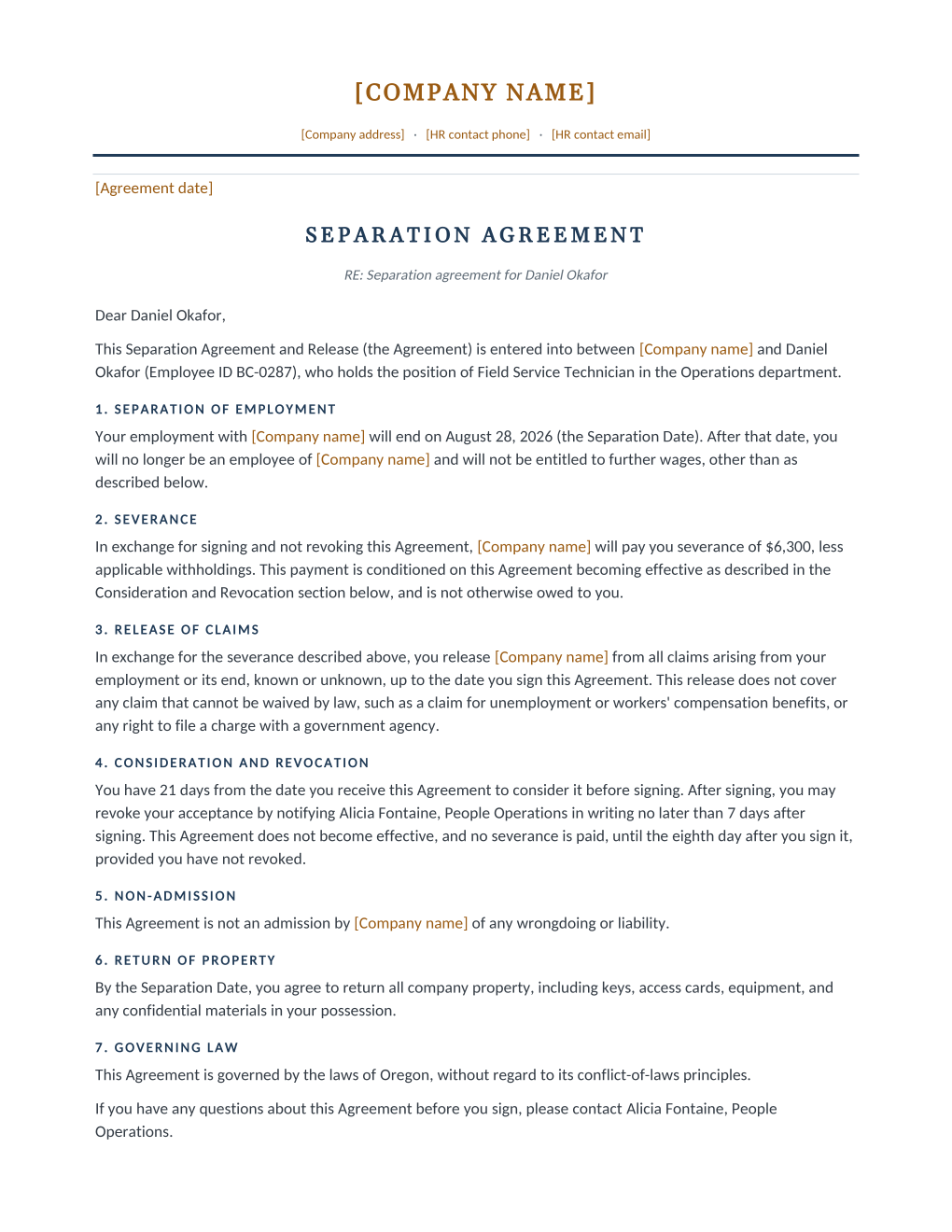
A separation agreement offers severance pay in exchange for a release of employment-related claims, on a consideration and revocation timeline set by federal law (and, in some states, extended further). It is typically offered during a layoff or a negotiated exit, not a routine termination.
A group layoff can mean preparing dozens of separation agreements at once, each with its own severance amount, consideration period, and revocation deadline calculated from the date it is sent. Upload this agreement as a Word template to MailMergic, upload a spreadsheet with each employee's terms, and generate one personalized agreement per row.
What is inside the Word download
More than a block of text an AI chat can improvise: a complete, formatted document built for HR teams who send it for real.
- Seven numbered clauses: separation, severance, release of claims, consideration and revocation, non-admission, return of property, and governing law.
- A Consideration and Revocation clause built around the federal OWBPA 21/45-day and 7-day timeline.
- A two-signature block for the company and the employee.
- Native Word merge fields for severance amount, consideration period, and revocation deadline, wired for a group layoff run.
The document
Copy the plain version below, or download the formatted Word document with your letterhead and layout built in.
{Agreement date}

SEPARATION AGREEMENT
RE: Separation agreement for [Employee Name]

Dear [Employee Name],

This Separation Agreement and Release (the Agreement) is entered into between {Company name} and [Employee Name] (Employee ID [Employee ID]), who holds the position of [Job Title] in the [Department] department.

1. SEPARATION OF EMPLOYMENT
Your employment with {Company name} will end on [Separation Date] (the Separation Date). After that date, you will no longer be an employee of {Company name} and will not be entitled to further wages, other than as described below.

2. SEVERANCE
In exchange for signing and not revoking this Agreement, {Company name} will pay you severance of [Severance Amount], less applicable withholdings. This payment is conditioned on this Agreement becoming effective as described in the Consideration and Revocation section below, and is not otherwise owed to you.

3. RELEASE OF CLAIMS
In exchange for the severance described above, you release {Company name} from all claims arising from your employment or its end, known or unknown, up to the date you sign this Agreement. This release does not cover any claim that cannot be waived by law, such as a claim for unemployment or workers' compensation benefits, or any right to file a charge with a government agency.

4. CONSIDERATION AND REVOCATION
You have [Consideration Period] from the date you receive this Agreement to consider it before signing. After signing, you may revoke your acceptance by notifying [HR Contact] in writing no later than [Revocation Deadline]. This Agreement does not become effective, and no severance is paid, until the eighth day after you sign it, provided you have not revoked.

5. NON-ADMISSION
This Agreement is not an admission by {Company name} of any wrongdoing or liability.

6. RETURN OF PROPERTY
By the Separation Date, you agree to return all company property, including keys, access cards, equipment, and any confidential materials in your possession.

7. GOVERNING LAW
This Agreement is governed by the laws of [Work Location State], without regard to its conflict-of-laws principles.

If you have any questions about this Agreement before you sign, please contact [HR Contact].

Sincerely,

______________________________
{Signer name and title}
For {Company name}
Date: ____________________

______________________________
[Employee Name]
Employee
Date: ____________________
Merge fields: one spreadsheet column each
Filled per employee in a bulk run, straight from your HR spreadsheet.
[Employee Name]Grace Lindqvist[Employee ID]EMP-5062[Job Title]Marketing Manager[Department]Marketing[Separation Date]August 29, 2026[Severance Amount]$12,500 (eight weeks of base pay)[Consideration Period]21 days[HR Contact]hr@lumenwaresolutions.com[Revocation Deadline]September 5, 2026[Work Location State]IllinoisFill in once before sending
Your own details, edited one time in Word (marked in amber in the download). No spreadsheet columns needed.
{Agreement date}August 15, 2026{Company name}Lumenware Solutions LLC{Signer name and title}Priya Anand, VP of PeopleSeparation agreement consideration and revocation add-ons by state
Under the federal Older Workers Benefit Protection Act (OWBPA), an employee aged 40 or older must be given at least 21 days to consider a separation agreement before signing (45 days for a group layoff), plus 7 days to revoke after signing; this baseline is the same in every state and is already built into the letter above. The table below lists state add-ons layered on top of that federal baseline, such as an extra rescission right or a required unknown-claims waiver, and covers US states only.
| State | Required notice |
|---|---|
| Alabama | No state add-on beyond the federal OWBPA baseline |
| Alaska | No state add-on beyond the federal OWBPA baseline |
| Arizona | No state add-on beyond the federal OWBPA baseline |
| Arkansas | No state add-on beyond the federal OWBPA baseline |
| California | A general release does not extend to claims the releasing party does not know or suspect to exist at the time of signing, and that would have materially affected the settlement if known, unless the release contains language expressly waiving this protection; separation agreements intended to cover unknown claims should quote or expressly waive Civil Code 1542 |
| Colorado | No state add-on beyond the federal OWBPA baseline |
| Connecticut | No state add-on beyond the federal OWBPA baseline |
| Delaware | No state add-on beyond the federal OWBPA baseline |
| District of Columbia | No jurisdiction-specific add-on beyond the federal OWBPA baseline |
| Florida | No state add-on beyond the federal OWBPA baseline |
| Georgia | No state add-on beyond the federal OWBPA baseline; Georgia is sometimes listed alongside California, Montana, North Dakota, and South Dakota as having an unknown-claims waiver statute, but no such Georgia statute could be located or verified |
| Hawaii | No state add-on beyond the federal OWBPA baseline |
| Idaho | No state add-on beyond the federal OWBPA baseline |
| Illinois | No state add-on beyond the federal OWBPA baseline |
| Indiana | No state add-on beyond the federal OWBPA baseline |
| Iowa | No state add-on beyond the federal OWBPA baseline |
| Kansas | No state add-on beyond the federal OWBPA baseline |
| Kentucky | No state add-on beyond the federal OWBPA baseline |
| Louisiana | No state add-on beyond the federal OWBPA baseline |
| Maine | No state add-on beyond the federal OWBPA baseline |
| Maryland | No state add-on beyond the federal OWBPA baseline |
| Massachusetts | No state add-on beyond the federal OWBPA baseline; Massachusetts courts require that a release of Wage Act claims be stated in clear and specific terms, but this rule comes from case law interpreting the Wage Act, not from a standalone release or revocation statute |
| Michigan | No state add-on beyond the federal OWBPA baseline |
| Minnesota | A release of Minnesota Human Rights Act claims may be rescinded by the employee within 15 calendar days of signing, regardless of the employee's age; this runs separately from, and can run concurrently with, the federal 7-day ADEA revocation period. The employee must be informed in writing of the right to rescind, and rescission must be delivered in writing within the 15-day window; a release given in settlement of a charge already filed with an agency or court is final on execution |
| Mississippi | No state add-on beyond the federal OWBPA baseline |
| Missouri | No state add-on beyond the federal OWBPA baseline |
| Montana | A general release does not extend to claims the releasing party did not know or suspect to exist at the time of signing, if knowledge of them would have materially affected the settlement, unless the release specifically and knowingly waives this protection |
| Nebraska | No state add-on beyond the federal OWBPA baseline |
| Nevada | No state add-on beyond the federal OWBPA baseline |
| New Hampshire | No state add-on beyond the federal OWBPA baseline |
| New Jersey | No state add-on beyond the federal OWBPA baseline |
| New Mexico | No state add-on beyond the federal OWBPA baseline |
| New York | No enacted state add-on beyond the federal OWBPA baseline as of this writing; a bill passed by the legislature (the "No Severance Ultimatums Act") would require a 21-day consideration period and a 7-day revocation period for all severance agreements regardless of age, but it had not been signed into law as of this research and should be rechecked before relying on this row |
| North Carolina | No state add-on beyond the federal OWBPA baseline |
| North Dakota | A general release does not extend to claims the releasing party did not know or suspect to exist at the time of signing, if knowledge of them would have materially affected the settlement, unless the release specifically and knowingly waives this protection |
| Ohio | No state add-on beyond the federal OWBPA baseline |
| Oklahoma | No state add-on beyond the federal OWBPA baseline |
| Oregon | No state add-on beyond the federal OWBPA baseline |
| Pennsylvania | No state add-on beyond the federal OWBPA baseline |
| Rhode Island | No state add-on beyond the federal OWBPA baseline |
| South Carolina | No state add-on beyond the federal OWBPA baseline |
| South Dakota | A general release does not extend to claims the releasing party did not know or suspect to exist at the time of signing, if knowledge of them would have materially affected the settlement, unless the release specifically and knowingly waives this protection |
| Tennessee | No state add-on beyond the federal OWBPA baseline |
| Texas | No state add-on beyond the federal OWBPA baseline |
| Utah | No state add-on beyond the federal OWBPA baseline |
| Vermont | No state add-on beyond the federal OWBPA baseline |
| Virginia | No state add-on beyond the federal OWBPA baseline |
| Washington | No state add-on beyond the federal OWBPA baseline |
| West Virginia | A state Human Rights Commission rule extends OWBPA-style protections to a release of any West Virginia Human Rights Act claim, not only age discrimination: at least 21 days to consider the agreement, written notice of the right to consult an attorney, and 7 days to revoke after signing, regardless of the employee's age; these periods can be waived when a filed complaint is settled with counsel involved |
| Wisconsin | No state add-on beyond the federal OWBPA baseline |
| Wyoming | No state add-on beyond the federal OWBPA baseline |
Last reviewed August 2026. Spotted a change in your state? Tell us at support@mailmergic.com.
These templates and state tables are general information, not legal advice. Employment law varies by state and country and changes often; the tables on these pages cover US states only, while employment documents like these can create binding obligations in any jurisdiction. Confirm the current requirements for your jurisdiction or consult an employment attorney before sending.
Before you send this agreement
- 1.Confirm the Consideration Period is at least 21 days for an individual, or 45 days for a group layoff, per the federal OWBPA.
- 2.Calculate the Revocation Deadline correctly, generally 7 calendar days after the employee signs.
- 3.Check the table below for any state add-on, such as an extra rescission right or a required unknown-claims waiver, before finalizing.
- 4.Do not backdate the agreement or shorten the consideration period.
- 5.Have counsel review before use, especially for employees aged 40 or older or a group layoff.
- 6.Keep the signed agreement and any revocation notice on file.
When to use this template
Group layoffs
Prepare a batch of separation agreements on a consistent consideration and revocation timeline for everyone affected.
Negotiated individual exits
Generate a compliant agreement quickly once severance terms are agreed.
HR and outside counsel
Keep the agreement wording consistent while counsel reviews the severance amount and any state add-ons per employee.
Send it to every employee at once
One document, one spreadsheet, one personalized copy per employee. That is what MailMergic is for.
Upload the document template
Use the Word download as-is, or edit it first. The merge fields are already in place.
Upload your employee spreadsheet
One row per employee: name, ID, role, dates, whatever the document needs. Excel, CSV, and Google Sheets all work.
Generate and deliver
One personalized document per employee. Download all as PDFs, or email each employee with delivery and open tracking.
Separation agreement FAQ
How long does an employee have to consider a separation agreement?
Can an employee revoke a separation agreement after signing?
Is severance pay required by law?
How do I prepare separation agreements for a group layoff?
Other HR templates
Offer letter
A formal offer with a terms summary table and a signature block ready for the candidate to accept.
Employment contract
Nine numbered clauses covering compensation, hours, leave, confidentiality, and termination.
Confidentiality agreement
Protects company information and assigns work inventions, with a state invention-assignment carve-out clause.
Performance improvement plan
Documented concerns, success criteria, support, and a review date, with a receipt-only acknowledgment.
Warning letter
A formal written warning with an incident summary and a receipt-only acknowledgment signature.
Termination letter
A termination summary table plus each state’s final paycheck deadline.
Disciplinary action form
A structured incident record with an acknowledgment signature, not an admission of agreement.
Employee information form
Employment details and emergency contacts in one form, with a signature confirming accuracy.
Onboarding checklist
Before day one, first day, and first month tasks, with a named buddy for every new hire.
All HR document templates
Browse the full set of free HR document templates.
These templates and state tables are general information, not legal advice. Employment law varies by state and country and changes often; the tables on these pages cover US states only, while employment documents like these can create binding obligations in any jurisdiction. Confirm the current requirements for your jurisdiction or consult an employment attorney before sending.